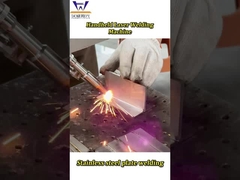
Kurzfassung: In diesem Video erfahren Sie, wie der QCW-Faserlaser-Schweißer die Anforderungen an lange Impulsbreiten und hohe Spitzenleistungen erfüllt und seine überlegene Leistung in industriellen Schweißanwendungen unter Beweis stellt. Erfahren Sie mehr über seinen stabilen Impulsausgang, die hohe Energiedichte und die Präzisionsschweißfähigkeiten für dünne Materialien und Mikrostrukturen.
Zugehörige Produktmerkmale:
Designed specifically to replace YAG laser welding processes with superior performance.
Features long pulse width output and high peak power for stable energy delivery.
Reduces maintenance costs and downtime frequency for improved operational efficiency.
Fully independently developed from beam splitting to control systems for reliability.
Delivers high heat input uniformity for precision seam and spot welding applications.
Minimizes heat-affected zone while improving welding precision on thin materials.
Achieves higher photoelectric conversion efficiency than traditional YAG lasers.
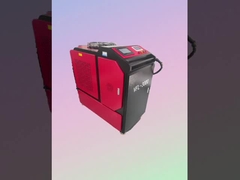
Compact air-cooled design with stable output energy for consistent processing results.
FAQs:
What makes this QCW laser welder suitable for replacing YAG laser processes?
This QCW fiber laser is specifically optimized to address the shortcomings of traditional YAG lasers, offering higher photoelectric conversion efficiency, more stable output energy, and a more compact equipment structure while maintaining or exceeding YAG welding performance.
What types of welding applications is this machine designed for?
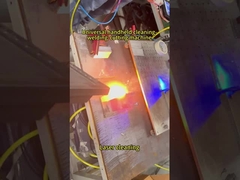
The QCW fiber laser welder is ideal for metal spot welding, precision seam welding, sealing welding, microelectronic welding, precious metal processing, and hardware product welding that require high heat input uniformity and precision.
How does the long pulse width benefit the welding process?
The long pulse width capability enables stable pulse output with high energy density, resulting in fuller weld formation, more controllable weld spots, reduced heat-affected zone, and improved welding precision, especially for thin materials and microstructures.
What cooling method does this laser welder use?
Both the HW-Q-150 and HW-Q-300 models feature air cooling systems, eliminating the need for complex water cooling infrastructure and simplifying installation and maintenance.